Monday, December 9, 2013

The Need for Passion
            Today, career politicians are lifted up and desired because of their experience, knowledge of how politics work, and their ability to adapt with the changes in political leaders and society. The problem with career politicians, however, is that all they know is politics. How can a career politician, especially one who is acting president, make decisions for the poor, and the common farmer, and the everyday American if his/her experience, and sometimes passion, is for politics and governmental affairs? Thomas Jefferson, a Founding Father of America, got wrapped up in politics but he had a passion for agriculture and gardening that kept him down-to-earth and sober minded. Presidents today should have a certain past time or passion that is not revolved around politics in order to keep themselves down-to-earth as well. Many presidents in the past as well as modern presidents today have had a passion for something other than politics that have allowed them to enjoy life and keep them sober minded on the eve of tough decisions, downed economy, and war.

Thomas Jefferson loved agriculture and gardening. He did not enjoy his political role after America had won its independence and therefore was always thinking of his home of Monticello. He wrote to his daughters constantly, asking every detail of the gardens. He wanted to know when a plant died, when a flower bloomed, and gave clear directions on what to do with every aspect of the gardens. When Jefferson was president and was stuck in New York, he did experiments of plants on window sills. Even the decision of purchasing the Louisiana Territory and to send Louis out to explore the land was a result of Thomas Jefferson’s passion for agriculture and desire of the United States to become and agrarian society. For the country to become and agrarian society, Jefferson knew that more land was needed and was ambitious to explore the area. When he sent out Lewis, he made sure to prepare him both in knowledge and in skill and ability so that the expedition would be a success. How sublime the United States became known as because of Jefferson’s decision, influence by his passion for agriculture, to take this necessary risk. Now, the United States is the number one exporter of agriculture.
            Thomas Jefferson also felt a need to get away from politics and used his love for agriculture to do so. During his time in Europe to make trade agreements and treaties in order to reopen up trade with Europe, Jefferson and Adams toured the well renowned English gardens. The two gathered details and interests in the gardens for their own gardens as well as using the time to still enjoy their love for gardens while they waited for the political leaders in London to come to a decision. Jefferson used what he learned in Europe to the United States to fight Hamilton on his manufacturing vision for the country, like changing the way rice was cultivated in the South. To relieve their headaches from debates and other political disputes, Thomas Jefferson and James Madison, even to an exploration through the Hudson River Valley. Now, Jefferson did use their trip for political purposes as well, like promoting the sugar maple tree orchards for self-sufficiency in sugar and forming political allies against Hamilton and other anti-federalists, but it was still a source of refuge for him to enjoy nature and gardening. Thomas Jefferson felt in prison in his last years of office and longed to return to his plantation and garden of Monticello.  He claimed “never did a prisoner, released from his chains, feel such relief as I shall on shaking off the shackles of power” (Wulf 173). Jefferson did not want the power of president and that is needed more in the leaders of today, for a person most fit to lead is one who does not want the power and responsibility in the first place.

            Great presidents throughout the United States’ history and modern presidents today have had certain passions or pastimes like Jefferson’s love for gardening and agriculture, which I believe helped give them refuge from the stresses of politics and allow them to remain sober minded decision makers. A few specific examples are Presidents Dwight Eisenhower, John F. Kennedy, George W. Bush, and Barack Obama. Politicians are pressured not to be perceived as slackers, however, I would argue that having certain passions and pastimes are important for politicians to have and fulfill while in office.

            President Dwight Eisenhower had a passion for golf. During his eight years in office as president, Eisenhower played about 800 rounds of golf (1,000+ Reasons, 2013). He was always trying to improve his game and said “If I don’t improve, I’m going to pass a law that no one can ask me my golf score” (1,000+ Reasons, 2013). Eisenhower used the golf course to form relationships with other leaders like Jefferson did with his trip through the Hudson River Valley, making his playing guests generals, representatives, senators, businessmen, and Richard Nixon. According to Arnold Palmer, President Eisenhower’s “visibility, coupled with his passion for the game, were the inspiration for literally millions of people picking up the game for the first time.” After his election in 1952, club members at Augusta National built a cabin for him with room for Secret Service. Ike’s Pond was named after him from Eisenhower walking through the woods and told Clifford Roberts, cofounder of the home of the Masters, he had found a perfect spot to build a dam for fishing (Ike’s Contributions, 2009). He also was put in the Hall of Fame for golf, though he never played competitively, and Eisenhower put in the first golf Course at the White House.
            Despite his heart attacks, intestinal illnesses, and mild stroke, Eisenhower could not get away from playing or watching golf. It is through his passion for golf that Donald O’Kieffe performed the first colonoscopy in Washington D.C. O’Kieffe was an American student in Cuba who was evacuated when Fidel Castro took over. He did not do much for his career until 1968 when Eisenhower had his second heart attack. O’Kieffe shared Eisenhower’s love for golf which is why he was asked to determine if watching golf on TV was bad for Eisenhower’s heart, diagnosing that watching Arnold Palmer play golf was. O’Kieffe settled in D.C. after observing Eisenhower and had many more political patience. In 1972, O’Kieffe had the only equipment needed for a colonoscopies and performed them before the scopes were made available commercially. Even with his passion for golf, President Eisenhower was still a well renowned political leader to the U.S. and free world and was a key leader during World War II.
(Collins, 2012).
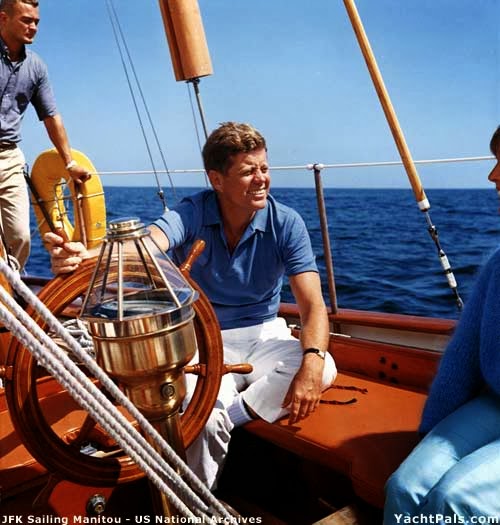
         
 John F. Kennedy’s passion and love was for sailing and the open sea. Kennedy started sailing as a young boy and won some events. He not only moved into the White House but also in the Presidential yacht, which he renamed Honey Fitz after his grandfather. According to Special Assistant David Powers, JFK would slip out of the White House to go spend a few hours on the yacht for some peace and quiet. He also spent many holidays like Easter and Christmas on Honey Fitz as well. Honey Fitz was not a sailing yacht, however, so Kennedy bought a 62 foot yacht that he had found at the U.S. Coast Guard Academy, naming it Manitou. Like Jefferson’s use of his agrarian passion to remain close to his family, Kennedy bought Manitou because it was a perfect yacht for his family to spend time together on. He put the latest communication equipment on the yacht so that he could stay in contact with his office and Russia while sailing.  JFK’s favorite boat, however was a 26 foot Wianno Senior called Victura, which was a 15th birthday gift to him from his parents. Kennedy taught many people to sail on Victura like his wife Jackie Kennedy. Sailing was always on Kennedy’s mind like gardening was always on Jefferson’s. During the Cuban Missile Crisis, Kennedy doodled pictures of Victura on many historic documents. Even on his last night before being assassinated, Kenndey thought of sailing. The hotel staff was cleaning his room when they heard the announcement of his assassination and found a hotel paper by his bed that had a picture of a small sailboat similar Victura drawn on it.
(B. Hampton & K. Hampton, 2010).

I really don’t know why it is that all of us are so committed to the sea, except I think it is because in addition to the fact that the seas changes and the light changes, and ships change, it is because we all came from the sea. And it is an interesting biological fact that all of us have, in our veins the exact same percentage of salt in our blood that exists in the ocean, and, therefore, we have salt in our blood, in our sweat, in our tears. We are tied to the ocean. And when we go back to the sea, whether it is to sail or to watch it we are going back from whence we came (Kennedy, 1962).  
For George W. Bush, his pastime has changed from smoking cigars to painting. He smoked cigars during his time in office, which I am sure helped relax him and gave him time to think while dealing with the war in Afghanistan and on terror. After he retired from office, he was anxious for a pastime, so John Gaddis, a Yale historian, told him to read Churchill’s book Painting as a Pastime. It started as an app on his iPad that allowed him to draw pictures, which were mostly stick figures to send to his family to say good night and good morning. Laura Bush showed them to a friend who thought they were creative, and, therefore, George Bush hired an art instructor.  According to his wife, George Bush is very determined and paints for hours each day. Just recently, George Bush painted a picture of Jay Leno and gave it to him on “The Tonight Show.” Bush enjoys painting and said that painting has changed his life. Like Jefferson’s return to Monticello to seclude to his garden, George Bush secluded to painting.
(Updegrove, 2013).
Today, the current president, President Barack Obama, has a passion for basketball and a pastime of golf. Like Eisenhower’s promotion of golf and Jefferson’s promotion of agriculture, President Obama has done much to promote the game of basketball.
He has played the game of basketball since his father, who left him and his family, gave him a basketball for Christmas 40 years ago. After being elected president, he gathered a few high school buddies, got the key to the old gym, and they played a pickup game. David Maraniss, in his biography on Barack Obama, wrote “basketball is central to his self-identity. It is where he found a place of comfort, a family, a mode of expression, a connection from past to his future” (Maraniss). Golf is now becoming Obama’s second passion. He has plaid over half of the 80 weeks he has been in office playing golf that he is starting to be compared with Dwight Eisenhower (Bedard 2010).
(Jackson, 2012).
            It is because of these passions that presidents and political leaders in the past have been able to stay sober minded decision makers. Many people lift up and desire for career politicians, but if all you care about and enjoy is politics, can you really make sound decisions for the citizens of America as a whole if you are not able to enjoy the simple pleasure and freedoms of America in the first place? All of these men, Eisenhower, Kennedy, Bush, Obama, and especially Jefferson are or were important leaders of this country but have never forgotten to retreat from the wranglings of politics and replenish their mind by a simple passion or pastime in order to truly make important decisions with a clear mind. As Eisenhower once said to another politician, “young man, let me tell you something. You are going to work fourteen hours a day, seven days a week for the government, and you are going to think you are doing your job. Here is what I want you to know. If that’s what you do, there is no way you’ll be able to do your job” (Natta, 2003).

References
(2008). 1,000+ Reasons To Like Ike. Golf Digest. Retrieved from http://www.golfdigest.com/golf-tours-news/2008-04/ike
(2009). Ike's Contributions to Golf Recognized. The Associated Press. Retrieved from http://sports.espn.go.com/golf/news/story?id=4289487
Bedard, Paul. (4 Apr. 2010). Golf Becoming Obama's Passion. Washington Whispers. Retrieved from http://www.usnews.com/news/blogs/washington-whispers/2010/08/04/golf-becoming-obamas-passion
Collins, Sonya. (11 Apr. 2012). How a Passion for Golf Sent a Slacker on His Life’s Course and to President’s Bedside. Yale Medicine Magazine. Retrieved from http://www.sonyacollins.net/2012/04/11/how-a-passion-for-golf-sent-a-slacker-on-his-lifes-course-and-to-presidents-bedside/
Hampton, Brad, and Kim Hampton. (21 Oct. 2010). John F. Kennedy's True Love. YachtPals. Retrieved from http://yachtpals.com/kennedy-sailing-boats-9161
Jackson, David. (10 June 2012). Obama's Lifelong Passion: Basketball. USATODAY. Retrieved from http://content.usatoday.com/communities/theoval/post/2012/06/obamas-lifelong-passion-basketball/1#.UpvHzMSkofU
Natta, Don V. (2003). First Off the Tee: Presidential Hackers, Duffers, and Cheaters from Taft to Bush. United States: Public Affairs.
Updegrove, Mark K. (19 Apr. 2013). President George W. and Laura Bush Reflect on the Twins, Bush's Newfound Passion for Painting, and More. Parade. Retrieved from http://www.parade.com/5964/markupdegrove/president-george-w-and-laura-bush-reflect-on-the-twins-bushs-newfound-passion-for-painting-and-more/
Wulf, Andrea. (2011).  Founding Gardeners: The Revolutionary Generation, Nature, and the Shaping of the American Nation. New York: Alfred A. Knopf.

James Madison: An overlooked president and environmentalist


 Who are the most important and fascinating presidents in American history? This is a question many may not know how to answer. This topic is one that will produce a great variety of results and opinions yet there seems to be a few names that repeatedly come about as innovators and cultivators of the America we so deeply love today. These men I refer to are the Founding Fathers of the United States of America including George Washington, John Adams, and Thomas Jefferson and the over-looked diamond in the rough, James Madison. It is not unreasonable however as to why James Madison is somewhat in the shadows and glanced over. Madison came to presidency after three of America’s most prominent presidents to this day, attempting to fill shoes of this caliber is a difficult task to achieve, yet one that I believe he achieved with flying colors.
                         
James Madison, although a subtler American president, had his hand in various political reformations and institutions both before his presidency and during, and helped construct the United States while keeping an interest an avid interest in the environment and his beautiful home at Montpelier. The multiplicity of his character astonishes and reminds one of a Jeffersonian type man with an interest for agricultural prosperity along with environmental protection. Madison, a man of the land, would be sure to hold an opinion, either good or bad, of modern society and our treatment of nature and what it gives us. Would he believe we have lost sight of beauty and instead destroy what nature has given us to innovate and build or would Madison see that we have found a new type of beauty in technology and industrial development? In either case what quandary I have found myself in is that since the dawn of human existence, the quality of environment and protection of it has decreased significantly and as time progresses, gets continuously worse. I believe Madison and especially his speech was the first cry for help and the first time a president has externally voiced his opinion, ultimately saving Virginia from collapse.

What Madison is most famous for is his didactic speech in which he described the problems he saw within our society, agriculturally that is. Madison saw what was happening and became disgusted with societies lack of respect for nature. The main topic of concern seemed to be deforestation to provide for greater amounts of livestock. Madison saw it as destructive that we essentially took more from the environment than we gave back and believed this ultimately hurt society and affected us negatively. Issues such as global warming, pollution and oil spills are all things that affect us environmentally today just as deforestation depleted the society in Albemarle and although they are different types of environmental destruction, the one thing they have in common is that humans are involved.    
With his love for agriculture, Madison promoted crop rotation and the horizontal tilling of land, which led to decreased erosion of the land as well as great economic prosperity. Madison also had had an eye for emerging technology and displayed this when he invested in a man named John Stevens, the first American to propose the idea of railroad trade. One of the most important aspects of Madison is realizing that many things he said and did had horticultural meanings behind them. His speech emphasized replacing what we take from the environment through activities such as using manure to fertilize freshly plowed land. To Madison, no tree should be cut down without having another one replanted. With such distaste for lack of respect for the land, it is interesting to wonder what Madison would say about modern environmental problems. We destroy land to build factories, companies, and industries that sustain our nation but at the same time destroy the environment. Our cars emit fumes that destroy the ozone layer while factories consistently pollute both the air and rivers. Madison was not only a man of politics and we can see this because he cared so deeply for the environment and agricultural beauty as a whole.
 Montpelier, Madison's large stately home in Virginia is another prime example of Madison's love for agricultural bliss. He held a special place in his heart for gardens, as did Washington, Jefferson and Adams. His home incorporated natural elements that surrounded the grounds and he purposely built his front porch to face the Blue Ridge mountains and his wheat fields. He wanted his home to have close access to everything, which brings about possibly the biggest issue of Madison's presidency, his slaves. At first glance when you see that his slaves' living quarters were essentially right next to the house one thinks that he deeply cared for his slaves and wanted them to feel like they were close to him not segregated off on his land. At second glance, it appears as though one could play devils advocate and state that Madison built the quarters so close to his house so he could constantly keep watch on his slaves. Either way, it is noted that his slaves were treated far better than slaves of this time, another overlooked quality of James Madison. 
James Madison was in a way a farmer before a president, yet he achieved so much without gaining the recognition the presidents before him received. His agricultural developments were the spark that revolutionized farming methods and still he made time to promote conservation of the environment. I believe James Madison is someone of virtuous character and to place him below the first three presidents of the United States of America is a mistake. Although different, James Madison left a mark on history that everyone should understand. 

Wulf, Andrea. Founding gardeners: the revolutionary generation, nature, and the shaping of the American nation. New York: 2011. Print.

Howsare, Erika. "James Madison, father of environmentalism?." cville. N.p., 11 march 2011. Web. 3 Dec 2013.

Wulf, Andrea. "Gardening as politics: Digging the Founding Gardeners." Los Angeles Times. N.p., 29 Mary 2011. Web. 9 Dec 2013. <http://articles.latimes.com/2011/may/29/opinion/la-oe-wulf-gardens-20110529>.

Clayson, Jane. "America's Founding Gardeners." On Point. N.p., 111 Apr 2011. Web. 9 Dec 2013. <http://onpoint.wbur.org/2011/04/18/founding-gardeners>.

America's Most Overlooked Founder


          To be a farmer is to be virtuous. A virtue is a positive trait or quality deemed to be morally good and thus is valued as a foundation of principle and good moral being. Personal virtues are characteristics valued as promoting collective and individual greatness. America's Founding Fathers understood what it meant to be virtuous and the importance of farming, gardening and the environmental impact it would have in developing the new republic of America. John Adams as one of the Founding Fathers understood the importance of this and his actions shaped the American nation and efforts today towards parks, farming, composition, and water conversation that echo his ideals. Adams regarded himself as a farmer first and always preferred being in his fields or in his garden to other pursuits. It was the “zeal in my Heart, for my country,” Adams said, that kept him in politics, not a particular love for it (Wulf 43). Adams impact on America is not through one action, but many actions represented through different themes from politics to agriculture. His virtuous passion for farming, gardening and nature was woven into the foundation of America into what has become an agrarian republic (Wulf, Gardening as Politics: Digging the Founding Gardeners).


  John Adams impact and legacy on America is unfortunately overlooked by many. Adams is viewed as the “odd-man-out” when compared to the rest of the Founding Fathers. His appearance did not exemplify the actions that one might envision after learning about his accomplishments in life. Adams was short, overweight, and verbose to a point of annoyance to some men. He did not fit the stature one would perceive as the second president of the United States. The rest of the Founding Father were all from Virginia, owned slaves, and were all financially much wealthier than Adams. But what they all did share was a passion for agriculture and it being the future foundation for America. Adams was fervent about his land and ever trying to improve it. He like the rest of the Founding Fathers claimed to be a farmer first, politician second. Adams was always looking for new ways to make his farmland more fertile, experimenting many a times with different compost and manure mixtures that no one else had conceived yet. He was not afraid to get dirty to say the least but where Adams lacked in appearance and social grace, he made up for in virtuous manner (Engle 10).

  Adams political life correlated with his passion for the outdoors and hands on technique. He believed Americans should lead a simpler life away from the hedonistic excesses of Europe and follow a path of civic duty, not individual gratification.The indulgence in luxury made people weak and effeminate, thereby corrupting a society, while public virtue was “the only Foundation of Republics” (Wulf 49). Adams admired the virtuous exemplifiers who served the public good and always found himself happiest when he was outdoors either farming or gardening and away from others where he felt he could be himself. “Never happier then when planting or pruning and overall getting my hands dirty” quoted Adams (Wulf 44). As a farmer Adams was naturally interested in getting dirty while as a politician he found himself estranged from his real passion. As Adams political career superseded his agricultural one, he turned to gardens as a way of escaping the every day head-aches and frustration of politics. Adams quoted, “Such excursions are very necessary to preserve our Health, amidst the suffocating Heats of the City, and the wasting, exhausting Debates of the Congress” (Wulf 44). It was these actions by Adams that lead to one his greatest impacts on America today.

  John Adams impact would result in the national parks found around the country. These national parks serve as a setting to investigate the role Adams played in establishing and perpetuating the American democratic tradition. Adams utilized nature as a resource to better himself. The National Park System is a national resource, a historical resource and a cultural resource. Like many other resources, it has value to man only when it is made useful to man. Adams saw this resource differ from other resources, chiefly in the nature of its products. Nature yields the products of knowledge, refreshment, and esthetic enjoyment Adams enjoyed throughout his lifetime. Adams would view todays National Parks as an encouraging effort to better society, a result mirroring Adams ambitions of America’s virtuous citizens.

  Adams impact on America and its foundation of success is only rivaled by the other Founding Fathers. The impact resulted from Adams love of nature and the resources they offered him to be a better individual, a virtuous individual with the only intent that it be the ultimate goal of every other American citizen to seize the same prosperity of heart and mind.


Works Cited

Engle, Corliss. "John Adams: Farmer and Gardner." Harvard University, n.d. n.p.: 9-14. PDF file.

Wulf, Andrea. “Gardening as politics: Digging the Founding Gardeners.” Los Angeles Times. n.p., 24 May 2011. Web. 23 Nov. 2013

Wulf, Andrea. Founding Gardeners. New York: Vintage Books, 2011. Print


Sunday, December 8, 2013

Thomas Jefferson and UVA

"I have often though that if heaven had given me a choice of my position and calling, it would have been on a rich spot of earth...No occupation is so delightful to me as the culture of the earth, and no culture comparable to that of the garden." 

                                                                 -Thomas Jefferson, 1811


Thomas Jefferson is well known as a forefather of this country, a leader, and an academic. It is rare to hear his penchant for gardening talked about in everyday conversation, but for Jefferson, gardening was a passion. He incorporated his love for nature and gardening into every aspect of his life, even academics. For Jefferson, learning was a crucial part of life. He was always looking forward, hoping to prepare the fledgling nation academically and horticulturally for the future. These passions combined in his architectural and environmental designs for both Monticello and the University of Virginia.


Monticello, originally a small eight room villa, was turned into a large twenty-one room mansion under the watchful eye of Jefferson after he returned home from the White House. Each of the rooms was carefully decorated with different elements of the outdoors. Jefferson carefully designed the grounds upon which the home was built, just as carefully as the interior of the home.  Jefferson wanted to make sure that everyone who visited his home had an opportunity to experience the natural setting surrounding the home. He kept many of the natural elements of the landscape, like the Blue Ridge Mountains, rivers, forests, and natural plants visible from the winding drive leading to the home. The journey from the main road to Monticello took visitors on a journey through the woods, next to carefully planted ornamental gardens, and along orchards, planted with hundreds of different species of fruits that Jefferson had collected through his many years of travel.  This is where his academic curiosity was most visible at Monticello. His academic curiosity was also strongly presented in his creation of the University of Virginia.


            Jefferson helped found the University of Virginia in 1819. His goal was to create a new kind of university; one which was publicly supported, nonsectarian, and dedicated to educating leaders. Jefferson considered the founding of the University of Virginia to be one of his greatest achievements. He carefully planned out the new university, much like he helped plan our nation from its founding. He carefully selected the 8 faculty when the University opened with classes offered in everything from ancient languages to law and medicine. Most interestingly, although the University was founded in 1819, it did not hand out its first degree until 1824, 5 years later. This was all part of Jefferson’s plan, as he did not believe in degrees, he thought of them only as “artificial embellishments.” I believe this truly speaks to the love and importance Jefferson placed on academics. He didn't want anyone trying to learn just to get somewhere else; he wanted people to learn for its innate value. This focus on academics is once again present in his architectural and environmental designs of the University’s campus.
               
                The University of Virginia was the physical manifestation of his educational, political, and cultural ideals. He designed the “academical village,” to be one where students and faculty lived close together, with the classroom nearby, helping to unite the living and learning arenas. Jefferson organized these building around “The Lawn,” and ended the space with the Rotunda. The Rotunda was designed by Jefferson as the architectural and academic heart of the “academical village.” The Rotunda originally served as a library, showing Jefferson’s belief that a university should have its focus set on a collection of academic achievements. The Rotunda was one of Jefferson’s favorite pieces of the University, although he did not live to see it completed, as it was the last building to be finished.  Jefferson planned the Rotunda around the Pantheon in Rome. The Rotunda is an exact copy, but with reduced measurements, as Jefferson did not want the Rotunda to dwarf the other buildings along the lawn. The Rotunda stayed in it’s original construction until 1853, when Robert Mills was hired to build an annex on the north side of the building to allow room for more classrooms. Sadly, in October of 1895, faulty electrical wiring in the annex started a fire. In an attempt to save the Rotunda, one of the professors attempted to dynamite the bridge between the annex and the Rotunda, blowing a hole in the Rotunda, and sadly causing the fire to spread more rapidly. The Rotunda was then rebuilt larger and with new materials, to help prevent future disasters. The building remained in this new fashion from 1898 to 1973, until it was finally transformed back to Jefferson’s original design. Besides the architecture, the grounds of the University of Virginia also contain more than ten carefully planned out garden pavilions. Jefferson’s hope was that the students would take an interest in gardening, as well as find solace walking through them. Many of these gardens remain to this day.


The buildings and the grounds at both Monticello and the University of Virginia are so beautiful, it is easy to forget how prudently planned they were by Thomas Jefferson almost 200 hundred years ago. So beautiful in fact, that the grounds of the University of Virginia and Monticello have been named a World Heritage Site on UNESCO’s list which includes other great architectural wonders like the Taj Mahal and the palace of Versailles. The plans were deeply rooted in Jefferson’s passion for agriculture, horticulture and knowledge, to create a stunning landscape to this day.


 From The Papers of Thomas Jefferson, The Albert & Shirley Small Special Collections Library, University of Virginia Library. Thomas Jefferson's Plan for the University of Virginia: Lessons from the Lawn. National Park Service, n.d. Web. 5 Dec. 2013.
 Monticello and the University of Virginia in Charlottesville. UNESCO, n.d. Web. 5 Dec. 2013. <http://whc.unesco.org/en/list/442>.
 University of Virginia. N.p., n.d. Web. 6 Dec. 2013. <http://www.virginia.edu/uvatours/shorthistory/>.

James and Dolley Madision

James Madison was the fourth president of the United States. He was well respected and liked as a president. Dolley Madison was an influential and important lady that stood by his side. She helped out James Madison if, when, and where needed. Dolley Madison was a socialite and understood the importance in creating relationships with other influential women. She was involved in charities, parties and other social gatherings. James Madison would not have been as successful of a president if it were not for his wife assisting in the areas in which she did. She used her charisma and hard work to help her husband become an even more influential political figure. Her ability to become a great first lady, certainly helped James Madison image and political power.
Dolley Payne was born on May 20, 1768, in North Carolina. Her family moved to Philadelphia, Pennsylvania in 1783. In 1790, Dolley Payne married lawyer and fellow Quaker John Todd, Jr. In 1793 Dolley’s husband and infant son William died of yellow fever. Because she lived in the capital of that time, Philadelphia, Dolley was able to meet many important and influential political figures and in 1794, she married James Madison. In 1801, when James Madison was appointed President Jefferson’s Secretary of State, the Madison’s moved to Washington, DC.  By this time, D.C was the new capital city.
She was one of the most well-loved first ladies. Dolley Madison was described as one of the most vibrant of the early First Ladies. She was outgoing and boisterous, fun-loving and kind. This is interesting because she was raised with Quaker roots. So I would think that she would be more quiet, and to herself. She served as Thomas Jefferson's White House hostess after his wife died and then she became the first lady once her husband won the presidency. She was active in creating weekly social events and entertaining dignitaries and other well-known members of society.  While the War of 1812 was going on, James Madison and his cabinet left when the British troops came and set fire to Washington D.C. Dolley Madison stayed back and understood the significance of the national treasures and keepsakes saved in the White House and would not leave without saving as much as she could, this included important documents, and a large portrait of George Washington. Because of her efforts and determination, many items in the White House were saved which would have most likely been destroyed or taken when the British captured and burned the White House.  Even though the city was in turmoil, Dolley Madison continued to host events and entertain in her temporary home.  She believed that this showed Americans the optimism and positivity of the city. This positivity is very important to have as a key figure in a society. While Madison was serving as Jefferson’s Secretary of State , Dolley co-hosted events that Jefferson felt needed a female presence. Jefferson was very much into parties and social events, and understood the importance of being a social. Dolley also played a large part in fundraising for the Lewis and Clark Expedition. This is a very important thing that many people could overlook. Fundraising for this, was something that was time consuming and was a great help for the expedition. Having a hardworking woman behind the scenes, really made a difference in the success of this trip.
James Madison was elected president in 1808. On the evening of James Madison inauguration in 1808, Dolley sponsored the first Inaugural Ball. Dolley was the first president’s wife to be formally associated with a public charity project. Dolley was very involved in charitable events, which made her husband look even better in the view of other Americans. The charity she sponsored was a home for orphaned girls in Washington, DC. Throughout her James Madison’s two presidential terms, Dolley Madison was a prominent woman in the political society. I think her biggest assistance to James Madison’s presidency was her ability to build relationships. She built relationships with various wives of important political figures. This allowed her to influence political opinions in the favor of her husband. After James Madison’s death, Dolley was forced to sell most of his property due to large debt. After this, she left Montpelier and moved to Washington D.C. She was awarded an honorary seat in Congress which allowed her to watch Congressional debates from the floor.
Although people addressed Martha Washington and Abigail Adams as “Lady Washington” and “Lady Adams,” it is said that President Zachary Taylor glorified Dolley Madison as the “First Lady”. Dolley set the standard for future First Ladies.
In conclusion, her ability to create relationships, involvement in the community, and willingness to help out where needed, makes Dolley Madison a great asset to James Madison presidential reign. Having a great First Lady could be overlooked by some, but I think that it is a key component for a successful presidency.
 
Bibliography
"Dolley Payne Todd Madison." The White House. N.p., n.d. Web. 09 Dec. 2013.
 "The First Ladies:." White House History. N.p., n.d. Web. 08 Dec. 2013.
 "First Lady Biography: Dolley Madison." Dolley Madison Biography. N.p., n.d. Web. 08 Dec. 2013.
 "James Madison : His Accomplishments, Ideas, Biography, Legacy, Impact, Western Culture, Civilization: Father of Constitution, Bill of Rights, Founding." James Madison : His Accomplishments, Ideas, Biography, Legacy, Impact, Western Culture, Civilization: Father of Constitution, Bill of Rights, Founding. N.p., n.d. Web. 09 Dec. 2013.
 "James Madison." Welcome to Montpelier. N.p., n.d. Web. 06 Dec. 2013.

The Father of the United States


           When someone thinks of George Washington, the first thing that comes to mind is usually the first President of the United States.  For someone with military background, possibly the great General who fought at Valley Forge, Yorktown, and the man who led his men across the icy Delaware to surprise the British army.  Possibly even someone with a political background would think of George Washington as the Founding Father who presided over the Constitutional Convention.  However, the last thing he is possibly ever known for is his international reputation as a farmer.  This reputation has been far overshadowed by his great public feats.
            Over one million people each year visit Mount Vernon, the home of George and Martha Washington.  They come with the hopes of seeing the great view of the Potomac, the magnificent house, and the burial sight of George and Martha Washington.  However, most people quickly walk past the part that George Washington himself loved the most about the property; the garden.


            It may surprise many that while Washington was planning these great military attacks to defeat the British; he was also designing new ornamental groves for his gardens at Mount Vernon. For Washington, a garden was a way to mentally escape from the fighting that was ensuing around him.  As Washington traveled around during the war, he would study soil and agricultural practices, and note different species of trees that he saw along the way. 
            Washington was a hands-on farmer.  While he had slaves that would tend the garden, Washington rode everyday no matter the weather to oversee the planting, growth, and harvesting of crops.  He selected which plants would be planted, and where they would be placed in the garden.  He took a scientific approach to farming, keeping meticulous notes everyday about the growth of the plants, even going as far as counting all of his plants and keeping track of when and how they perished. 
            Washington started as many farmers in the Americas did, as a tobacco farmer.  This was the leading cash crop, as it was being sold to the British merchants in great quantities at the time.  However, tobacco had devastating effects on the soil.  For Washington, tobacco was a horrible crop to grow not only due to the fact that it depleted the fertility of the land, but also because it showed a dependence on British markets.  For this reason, in 1766, Washington quit growing tobacco and began growing wheat, corn, and other grains.
            Upon returning from war, one thing Washington said was that he would work on replenishing the fertility of his soil that was depleted from the growth of tobacco.  He did this by trying many different experiments.  The first few experiments involved finding different types of fertilizer, as manure, compost, or dung was considered necessary to all soils. 
            In April 14, 1760, Washington described in his diary an experiment to determine the best compost for plants. He set up a box with 10 compartments, each containing plants from the garden. The first box was the control, and in the others he added equal amounts of compost, dung, or mud from the Potomac River, which he referred to as "Black Mould." In each compartment, three grains of wheat, oats and barley were planted at equal distance and depth. The results from the experiment showed that the best compost was the hardest to come by, the Black Mould, due to its extreme difficulty in collecting.
            Dungs that Washington used included human dung that was collected from the necessaries that lined his bowling green, and manure collected from animals such as cow, oxen, hog, sheep, horse, and chicken. Of all the dungs that were tested, horse manure was considered the best, but dung from cow, oxen, hog, and sheep all had their good qualities and were suggested for use. There was a warning about pigeon and chicken manure because it was very hot and could burn plants. When it was to be used, Washington suggested using half as much of that material than the others.
            Other things that Washington was interested in experimenting with were non-native plant species.  Plants that were sent to him by friends of other countries were used in experiments to see how to get them to survive in the harsh climate of Virginia.  He used a small botanical garden to carry out these experiments, which he often referred to as “the little garden by the salt house” He would do all of the planting and cultivating himself for this garden. One of the more unusual plants was hundreds of Chinese seeds that were planted in one quarter of the garden. Unfortunately, none of them sprouted. Washington was quite exact with his personal plantings, as shown in his diary entries. On the April 7, 1787, he recorded, "In my Botanical garden in the Section immediately adjoining to, & west of the Salt House I sowed first 3 rows of the Kentucke clover 15 inches apart and next to these 9 rows of guinea grass in rows the same distance apart."


            Washington was so obsessed with experimenting with exotic plants that he built a greenhouse that was similar to a structure in Baltimore, Maryland to house his plants that he knew would not survive the winter. The Greenhouse provided a winter refuge for tropical and semi-tropical plants such as coffee, orange, lemon, lime, sago palm, and aloe. 
            Washington also did experiments with animals at Mount Vernon, such as using selective breeding techniques with sheep to produce a better quality of wool and the use of a Mule.
            Washington experimented with around 60 different types of plants including: Hemp for making linen, cloth and rope; cotton; silk and flax.  Through his work with experiments, Washington was able to find better and more advanced ways of cultivating these crops.  His overall goal was for the United States become a self-sufficient country leaving all memories of Europe behind. 
            One of the best examples of Washington’s pioneering feats in agriculture is the use of the Mule. Washington found that Mules were more docile than a donkey, less fragile than horses, and inexpensive to maintain.  Washington cunningly bread mules, which until then hardly existed in the country.  This has led to some calling Washington the Father of the American Mule.


            Washington’s experiments in agriculture changed the way people farmed their fields.  He saw farming as a way to separate the United States from Great Britain. Washington believed that “ in the present state of America, our welfare and prosperity depend upon the cultivation of the lands and turning the produce of them to best advantage.”  Through his work in all fields: Military, Political, and Agriculture; he is truly seen as the father of the United States.